Showing posts with label Homebrew. Show all posts

Tuesday, September 22, 2009

Bigger than planned

I haven't brewed nearly enough over the last few months. It was time to remedy this with a bang, so last weekend I planned to brew an American IPA. It got away from me a bit  thanks to some overly zealous hopping (is that possible in an American IPA?) and a better than expected extraction of sugar from the mash.

25 litres
5 kg Maris Otter
2 kg Munich malt
500g Cara Munich

35g Galena 13% AA 60 minutes
25g Centennial 10.5% AA  20, 10, 5, 0 minutes

OG 1.078

60 IBU estimated

Saf 05

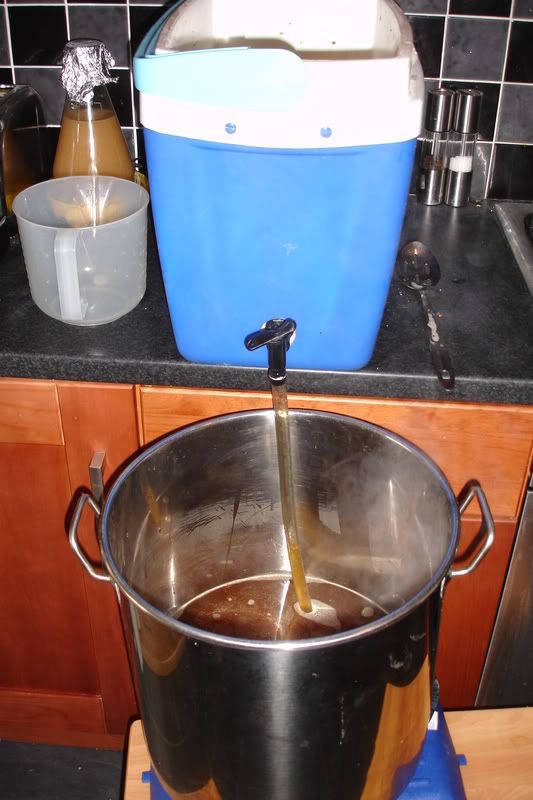
I gave my mash tun a serious workout and it held up admirably. Once again I treated my water, bring the calcium up to around 160 ppm through additions of calcium sulphate and calcium chloride. I rid myself of around 130 ppm of pesky alkalinity using carbonate reducing solution and everything went very well indeed. I planned for 75% efficiency and an OG of 1.070, but achieved about 80% and ended up with 1.078. Very gratifying but the fact that my last runnings came in at 1.030 indicates that I just can't get the damn fermentable sugar out of the mash tun. The chemistry was perfect; the temperature held at 66 C and pH fell in a spot on 5.4, but the damn grain held on to the sugar. Not to worry. I'm not a penny pincher and have no problem dumping the grain. Perhaps in future I'll do some small beer.

I opted for some first wort hopping because Galena can be a little harsh,  and also the hop rate was quite liberal. I used pellets for the Centennial and had to break out some extra kit to cope with all the pellets. I planned to make a big beer with plenty of rich malt for quite some time, the hope being that the richer Munich malt will provide a decent base for the hops.

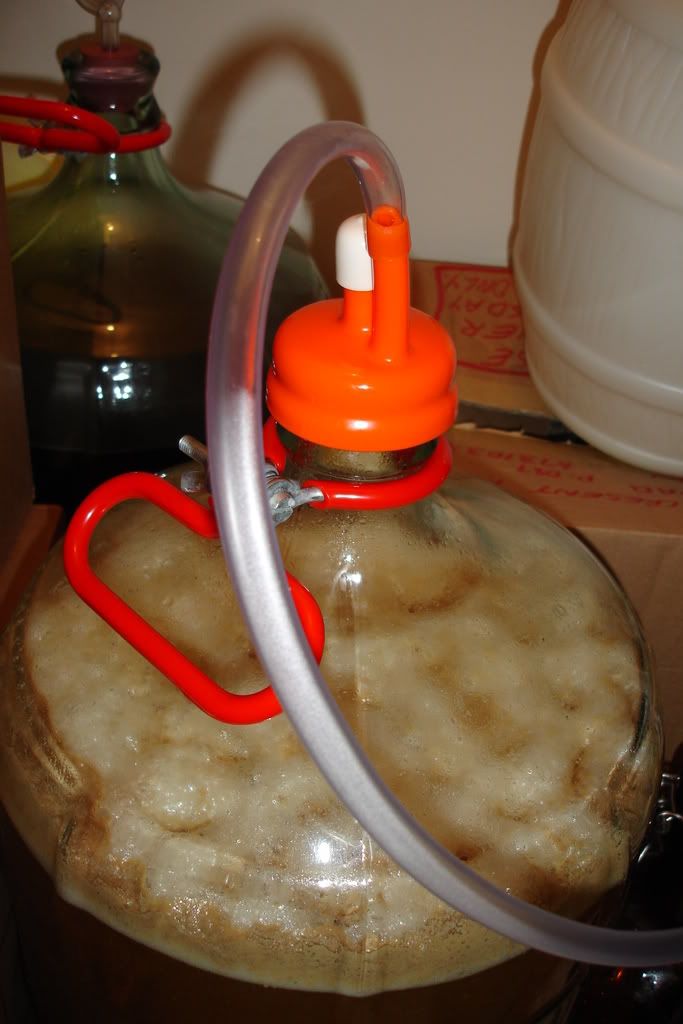
Below is a video of Saf 05 yeast hard at work. The wort looks like swamp water because my set up dumps all the break material into the fermenter, but the beer generally drops bright in the end with no ill effects.

Thursday, August 20, 2009

I knew I'd regret it

I feel as if things have been busy lately. Perhaps they have, but I still can't justify the degree of neglect this blog has received. My laziness came back to haunt me again earlier this week when I decided to stuff my Cobweb Ale into a Cornelius keg that was in no way ready to hold it. I bought the kegs a few months ago, but owing to lack of space I have yet to get a fridge to put them in or any gas to run them. But that didn't stop lazy old me from racking 18 litres of ale into one. It was part laziness - the thought of preparing and sanitising sufficient bottles horrified me - but also I thought I had found a way around the gas problem by buying some small 16 gram CO2 cartridges that I could prime the keg with. I knew I would run into trouble but it didn't stop me because the beer had sat on a bed of dead yeast for far too long and a move had to be made.

So I whacked the ale in the keg along with some finings and priming sugar just before I set off on holiday for a week, and returned to find the keg nicely pressurised but not at all bright and tasting kind of sharp. I think the beer was off before it went in the keg, but it became clear that any chance I had of properly carbonating it was ruined after a glimpse at the gas pressure tables told me that at the ambient 20 C the beer was sitting, a pressure of around 24 pounds per square inch is required to get sufficient gas into the beer. That's higher than the keg is rated for, I think.

A fridge is definitely in the pipe line.

Saturday, July 11, 2009

Cobweb ale

I dusted the cobwebs off my brewing equipment yesterday. Literally. Too long a stint in the attic draped them with silken threads. Another golden ale was my plan yesterday, but this time with a little more body than the last one. To this end I added 10% dextrin malt to the grist, which will fill out the body but will not alter golden colour I desire. It looked like this:

3.9 kg Maris Otter
400 g Carapils

35g Northdown 60 mins
15g Cascade 20 mins
15g Centennial 10 mins
15g Centennial 0 mins

Mashed at 66 C

40 IBU

Saf o5

OG 1.040

I made modest additions of calcium sulphate and calcium chloride to boost the calcium in my liquor and add some fullness. I had to make some major adjustments to my tap water because a grist that pale will not tolerate 200 ppm alkalinity, which is what I found in my water. I used lactic acid to bring the pH down to around 5.5 which corresponds to alkalinity of around 25 ppm.

While brewing I sampled two ales from this quarter's CAMRA beer club delivery. Interestingly, in the literature with the delivery CAMRA almost apologised for the inclusion of a golden ale, noting that a great many of them are not up to standard. I have whinged about this for quite some time, having been plagued with entire deliveries from CAMRA of listless, thin and gassy golden ales. Crop Circle from the Hopback Brewery was the worrisome golden ale in this delivery, but it can't be dismissed as bland. In fact this ale packs quite a bit of flavour, with a harsh hop character. Lemons strike you on the nose and the addition of maize to this beer gives it a lighter body. Along with this I tried Potholer from Cheddar Ales. This is my kind of English ale. Full biscuit malt with lip smacking, well rounded hop bitterness, topped off with rich foam and a mouth watering copper hue.

Friday, April 24, 2009

The shop around the corner

Well, it's not exactly around the corner but it is close enough to get to with ease. I was very surprised to see home brew equipment and ingredients available on the shelves of my local Nature's Way health store The Health Store. I know it was once quite a common occurrence but I never saw it personally. Perhaps it is recessionary cliché thing, but I'm happy that it is there both as a source of the simpler bits of kit (I spotted finings, bubblers, caps and campden tablets) but also because it might encourage more to take up home brewing, which can only be a good thing for craft beer in Ireland.

Sunday, April 5, 2009

The Big Fella

I have yet to brew a big beer in my home brewing career. Yesterday I decided to make the move and put together this:

20 Litres
Maris Otter 5.4 Kg
Dark Crystal 400g
Special B 400g

44g Challenger @ 60 mins

1 sachet of S0f 04 + 1 sachet of Danster Nottingham

OG 16 Plato (1.064)

This should be plenty rich and if I have the will power I'll leave it for a great many months to mellow out. All did not go well with the mash, though. Dark crystal and Special B pack a great deal more acidity than I thought and as a result the pH of the mash dropped to around 5.0 and without any carbonate to correct it I could do nothing but hope it worked out. Mash pH that is too low is always preferable to one that is too high but a low mash pH causes increased extraction of nitrogen compounds and a longer time is required for extraction to occur. To try and counter the effects of the low pH I mashed for 30 minutes longer than usual, but this didn't fix the matter entirely because the OG is lower than I had anticipated. Not to worry, it is respectable and should make for a decent strong beer. I mixed yeast because I didn't have two matching sachets and needed the extra pitching level for the high OG. Let's hope the two strains play nice in the wort and don't do anything petulant like refusing to flocculate.

While I had all the brewing kit out I took the opportunity to bottle my last beer. It is something of a disappointment, but in some respects exactly what I was shooting for. I used solely base malt and got exactly what I expected; a light beer lacking in body. The hop character isn't too bad, mainly due a healthy measure of dry hopping with Cascade, but the over all impression is one of a thin beer with no length. It reminds me of a number of unsatisfying golden ales I have had on cask around Britain. I often wondered how they managed to make a beer that had so little body, and now I know. A measure of speciality malt is definitely required to pad out golden ales; cara pils is great for this, but Munich or Vienna malt will do the job without darkening the beer too much.

Tuesday, February 17, 2009

Single Malt Cascade Challenge(r)


I like challenger. I like cascade. John suggests this combo in an ale is excellent so at the earliest opportunity I wanted to test this out. I'm off work this week so grabbed the chance to do some midweek brewing, something I never get the chance to do. The recipe looked like this:

4.3 kg Maris Otter

Challenger 40g 60 mins
Challenger/Cascade 20, 10, 5, 0 mins

Mashed 66 C

1.5 litre British ale yeast starter

OG 11 Plato

The most important thing about this brew was ensuring that I had removed all the alkalinity from the water because a grist composed of entirely pale malt will not tolerate much alkalinity and cannot produce enough acidity to counter the buffering effect of carbonates. I took care of this with an acid blend solution and the mash went well. The beer will be golden in colour but perhaps not as light as it could be due to some inevitable darkening during the boil. The beer is appropriate. The sun came out today and a distinct spring warmth was in the air and this beer will be a refreshing golden ale, slightly lower in alcohol than the beer I brewed over the winter and well suited to drinking in quantity.

Sunday, February 1, 2009

Old Smoky

I have avoided using smoked malt up to now because I find the phenols a little difficult to deal with. The Bamberg type smoked ales are like smoked bacon in a glass to my mind and a little hard to stomach. Recently however I have developed a taste for Islay single malts which are very high in peat smoke phenols indeed. As a result I decided a hint of this in a porter might not be a bad thing. There are problems with this because I had no idea how much smoked malt to use to get the hint of smoke I wanted. Anyhoo, the recipe looked like this:

Maris Otter 3.8 kg
Smoked malt 500g
Chocolate malt 250g
Black malt 200g
250g Muscovido dark sugar

Pilgrim 40g 6o mins
Pilgrim 15g 20 mins

Mashed at 67 C

OG 12 Plato

1.2 litre British ale starter

In the end I just added all the smoked malt I had. It didn't smell that strong from the pack and didn't dominate the wort in any way, so I shouldn't have to worry about an imbalance. I think my brewing software overstated the extract from some of the malts because the gravity fell short and I also took off a bit more sparge than intended, but I didn't want to boil for longer to concentrate the wort so threw in some rich brown sugar. It should add a little more complexity and brought the gravity up to a respectable level.

I also loaded the liquor with calcium chloride to make up for the poor levels of calcium in my water and add some fullness. I am interested to know just how high a concentration of various salts brewing liquor can bear before it starts to have a negative effect on the beer. Burton brewing water has around 700ppm sulphate which is very high indeed and makes for very hard water. Burton ales have always been known for excellent clarity, but it took an understanding of brewing chemistry before it was established that the very high levels of calcium in the brewing water was contributing to excellent break formation and yeast flocculation. I plan to play with water treatment over the next few brews to see what improvements various salts may add to my beer.

Tuesday, January 20, 2009

Pilgrim's Progress

Last weekend saw another attempt to brew a straightforward ale. It looked a little like this:

4.6 kg Maris Otter
250g 120L crystal malt

Pilgrim 11.3% 60 mins
Willamette 4.4% 20, 10, 5, 0 mins

Mashed at 66 C

OG 12 Plato

Saf 05

This beer has a number of new elements; I have never used Pilgrim or Willamette before and look forward to see what kind of flavour they'll give the beer; I loaded the water with calcium sulphate and calcium chloride, bringing the the calcium concentration up to around 250ppm which will have aided the mash, break formation and the yeast in their work as well as adding fullness to the beer and enhancing hop character; finally I used my new wort chiller which proved very effective, dropping the temperature very rapidly initially but also got the wort to room temperature far quicker too. Along with this I tightened up just about everything else in the process to try and get a clean tasting beer. I'll keep you posted.

Tuesday, January 13, 2009

Unexplored potential

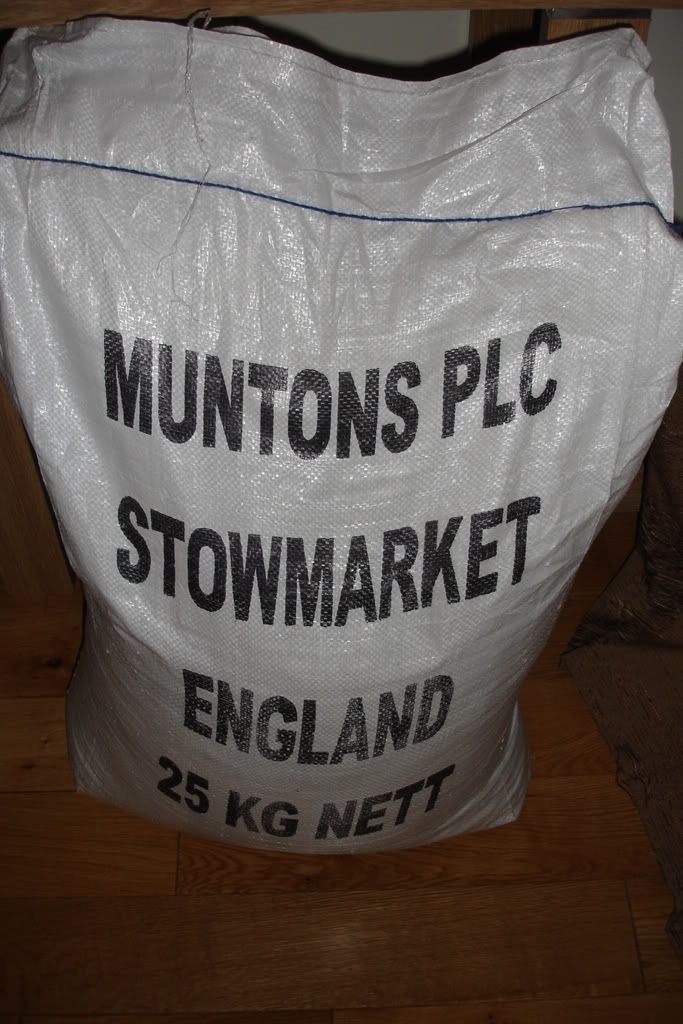
The potential is breathtaking. What you're looking at is 25 kg of some of the world's finest two row pale malt. Maris Otter, to those in the know. It is without form, ready for crafting into any number of fine beers. Crisp pale ale? Without doubt. Rich barley wine? Certainly. Smoked porter? Perhaps. Whatever takes my fancy. But my excitement is met by trepidation in equal measure. Sadly my brewing endeavours have not gone to plan over the last 6 months or so. I have ditched a hundred litres of beer because of a stubbornly persistent off flavour that I cannot shift.

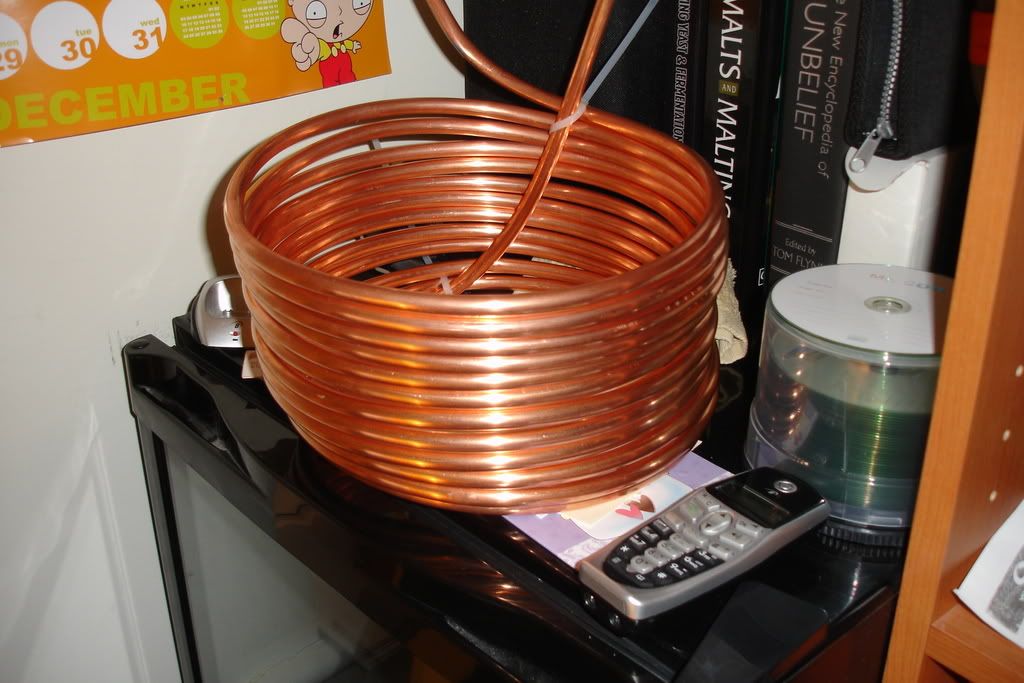
Remember this ale? It was my return to the mash tun after a long break, and to be honest I was certain that it would be taint free thanks to a tightening of my brewing technique. Sadly it was not, so this is my next offensive against the nasty flavour; a new fully pimped home made wort chiller. It has far greater cooling capacity than my previous one and should cool things down far quicker and prevent me, through sheer impatience, from aerating the wort at too high a temperature. You see, my existing wort chiller takes an age to get wort down to room temperature. It'll drop the first fifty degrees centigrade very rapidly indeed which takes care of all my my cold break requirements, but I simply cannot wait the length of time required to get the wort down to 20 C. As a result of this, and other things peculiar to my brewing set up, the wort tends to get aerated at around 25 C and sometimes a little higher. My latest vexed theory is that this is oxidising my break filled wort and precipitating the pesky off flavour. This coming weekend should see the test of this theory, but in the meantime can any brewers out there let me know if they are impatient like me, or having greater brewing maturity, ensure that their wort is plenty cool before aeration?

Monday, December 8, 2008

Back To the Tun

I have been away from these pages for a while but once again with good reason; I finished my brewing exams last Friday and found myself without a minute to do little else except work my day job and wearily trawl through study notes. I could have done the whole thing more intelligently. Last year I opted to cover all the really interesting brewing science aspects which I enjoyed greatly, but for the last six months I have struggled through hundreds of pages of engineering and process technology. Don't get me wrong, this stuff is essential to brewing, particularly at large volumes, but it was very mathematical, covering fluid flow, pressure changes and refrigeration cycles among many other topics. It was all a bit difficult for a lowly biochemist to cope with.

To ease the pain somewhat I dusted off my brewing equipment on Sunday and set about brewing a pale ale. I had in mind a winter type ale gently spiced perhaps but then realised that it was in fact nearly mid December and it would never be ready for Christmas and besides, my recent attempts at any beer had been awful suffering as they did with a flavour I can't account for but suspect stems from oxidation of hot cloudy wort. With this in mind I thought a straight down the line pale ale was in order to see if in fact I could brew beer at all, let alone fancy spiced ones. The recipe looked a little like this:

4.8 kgs Maris Otter
300g Crystal 60L

46g Target 9% AA 60 mins
30g Challenger 7% AA 20 mins, 10 mins
25 g Progress 5 mins, 0 mins.

Mashed at 66 C

Saf 04

OG 1.048

Some of you with a built in bittering units calculator might note that the amount of bittering hops is mental, and you would be correct. I had small amounts of hops lying around the place and just decided to throw them all in to tidy the freezer up. As I said, I am interested to see if I can brew beer at all, let alone a well crafted one, so I went a little slap dash and just used up all my spare hops. It might not be too bad; if that bloody flavour turns up again perhaps the hops will drown it out.

Tuesday, November 11, 2008

Dream Porter

It's a damn fine looking beer and no mistaking. It tastes pretty good too, but not as good as it could and I have learned a number of lessons in the brewing of this porter; there is a limit to the amount of dark malt that can be added to a beer with the hope of making it black. Roasted barely or patent black malt will black it up a treat but you'll struggle with chocolate malt, even heroic amounts of it. I didn't want to use any of the more acrid malts so opted for brown and chocolate which accounted for around 15% of the grist. Despite this the roasted notes aren't what they might be and the beer is also a bit thin, much like home brew made with too much sugar. This is down to the the high percentage of dark malts which don't add much in the way of fermentable sugars and so left the beer a little thin with insufficient pale malt to pad the whole thing out. Next time I plan to ease back on the roasted malt, but add some black malt which is potent stuff and shouldn't be required in large amounts to darken the beer and add roasted character. I'm determined to crack porter brewing. I want a full beer with decent malt character complemented with a rich roast flavour and perhaps a hint of hops. Is that too much to ask?

Saturday, September 6, 2008

Biscuit Beer

This will likely be the last beer I brew before my wedding as the next few weeks will be hectic what with wedding plans and brewing assignments. I planned a very straightforward ale today with only pale and crystal malt, but when I took a look through my supplies I spotted some biscuit malt, the presence of which had slipped my mind. I decided to add it to the grist for today's brew with the hope that it will provide a fuller malt aspect to the beer. Initial tasting of the sweet wort certainly suggests this will be a rich beer, so I hopped it quite well to balance the malt. This one should be English through and through because coupled with the English malts, I added a good measure of Challenger and Northdown along with a British ale yeast strain from Wyeast.

My yeast propagation endeavours are working a treat, and saving me money which is an added perk. The plate stirrer method I employ for making starters is producing a vast mass of cells for pitching which enables me to make parallel starters by pouring off a few hundreds millilitres of starter into bottles and storing them in the fridge. These in turn can be used to make further starters thus enabling me to get a number of brews from one yeast pack. This only works up to a point because yeast don't really like sitting in an alcohol infused medium for too long and will start to mutate or just plain kick the bucket. A bit of reading around has suggested the little fellas will happily sit in the fridge for around 6 months before I have to start worrying about a detrimental drop in viability. There are quite a number of other methods to store yeast in the long term involving nutrient plates, slopes and deep freezing, but I'm not prepared to go down that route just yet. It isn't really necessary and the yeast cultures I used are commercially available and easily replaced. I suppose if I developed a particular house strain that I liked I could attempt to preserve it but that seems most unlikely from the home brew perspective.

Thursday, September 4, 2008

It'll taste better than it looks, I promise

I broke out the mash tun again last week. I was keen to do so after the disaster of my last two batches. As a result of those mishaps I haven't had any success in the brew house since my very tasty Industrial Stout and wouldn't generally brew another dark beer quite so soon, but my recent Sierra Nevada Stout encounter tipped the balance and edged me to brew another porter. I have a theory that a great deal of the American dark beer I drink has a fair measure of Vienna or Munich malts which contribute to the rich fullness that is the most striking aspect of these beers. The porter I put together is something of a hybrid because I love English porter, the best of which is often typified with a brown malt contribution, while American porters and stouts are hopped a little more and use richer malts. When formulating the recipe I opted for equal measures of brown and Munich malt but in the end opted to half the brown malt contribution to make it a little more American, but then at the last moment threw in a handful of East Kent Goldings to the boil, which makes it more American, I suppose, but the hops are English. In the end it really doesn't matter. All I'm looking for is a full flavoured porter which I think I might have achieved, judging by the sneaky taste I had while transferring it to secondary fermentation. The unappealing gunk in the carboy above is the stuff left after primary fermentation. Brewing is a messy business with lots of funky stuff produced, but the finished product is usually good, hard as it may be to believe from the above picture.

It's really very easy to over think beer recipes, when in fact the simplest concoctions will produce excellent results providing the other aspects of the process are looked after, in particular the fermentation. Most home brewers do not give enough regard to their yeast, which is a pity because they often put a great deal of time and thought into sourcing the ingredients and blending them is such a manner as to produce the beer they long for. In general, home brewers under pitch their yeast because they cannot produce sufficient cell mass in the average starter,while at the other end of the scale some massively over pitch by racking their most recent brew onto the yeast cake of a previous one. Neither of these are conducive to nice flavours in the beer, but we often have no choice but to work within the restrictive environment of our kitchens and garden sheds. This latest brew was my first attempt at pitching a specific amount of cells per millilitre of wort, but counting the cells proved more difficult than I thought, mainly because I allowed the yeast to sediment and it produced a very firm slurry which couldn't be readily re-dispersed into solution. This of course ruined any chance of counting the yeast in the starter because it was no longer homogeneous. I am determined to persevere with is because pitching the correct amount of yeast is fundamental to good beer production, and I plan to figure out how to do it.

Sunday, August 17, 2008

Good News for People Who Like Bad News

Tragedy has befallen The Black Cat Brewery. No no, Oscar the brewery cat is fine, but an alteration to my brewing technique, in an attempt to optimise the brew day, has ruined two batches of beer. I should have known better because hot wort really doesn't like to be aerated. I was all too aware of this but thought I was gentle enough with the swifter transfer of the wort in order to speed up the run off from the mash tun. The upshot is 50 litres of beer with a particularly unpleasant flavour, that my beer suffered from in earlier years, but I managed to eradicate. It is a peculiar flavour that I can't stomach, but other home brew chums of mine seem to be unable to taste it. The only positive I can take from it is the identification of the source of an off flavour, and it is always nice to figure out where particular flavours, good or bad, come from.

Thursday, July 17, 2008

Making Progress

Since I hadn't got around to packing away my brewing equipment and having shaved over an hour off my brew day thanks to a few tweaks, I decided to put an English pale ale together today. I have brewed quite few aggressively hopped American pale ales and find that American aroma hops are very well suited to liberal dosing, but I have never attempted the same thing with English hops, fearing that it just wouldn't work out. This brew was an attempt to see if English hops can be used in almost the same quantities with good results:

4.60 kg Maris Otter
200g 75L Crystal

36g Target @ 60 minutes
16g First Gold @ 20 minutes
12g Progress @10 minutes
12g First Gold @ 5 minutes
12g Progress @ 0 minutes

Mashed at 66 C

Anticipated IBU 40

OG 11 Plato

Gervin English Ale Yeast

I am not familiar with Progress and don't know what exactly it will bring to the beer, but part of the idea of these fairly aggressively hopped ales is to decipher the specific flavour profile of certain hops and discern how they might best be used. I have used First Gold before and don't consider it that special, but it has further interest to me because it is a dwarf variety and therefore much more amenable to growth in my back garden because it will only grow to 2 or 3 metres compared to traditional hops that grow to twice that and require extensive rigging. I have a spot in mind, a sunny corner that gets quite toasty warm when the sun bothers to come out from behind the permanent carpet of cloud that cover this small country. It would have to be a long term plan because little can be expected until at least two years into cultivation, and the yield would be little even after the plant had matured. I wonder what kind of barley yield I'd get from my back garden....

Tuesday, July 15, 2008

Another Golden Ale

It's Summer time here in Ireland (apparently) so it is only proper that I brew a golden ale to reflect the lazy summer days. In truth, summer hasn't really kicked off in Ireland yet and is unlikely to, save for a few sunny days here and there, so this isn't the real reason I brewed a golden ale. My true motivation is a sustained disgust with so many of the golden ales that have been inflicted upon me over the last year or so. They proved more often than not to lack any body or flavour and were invariably gassy as hell, no doubt in an attempt to offer a refreshing experience. My previous golden ale was a similar protest brew with an American slant. This one has a decidedly English lean to it, except perhaps for the Styrian Goldings, but they strike me as a good hop for a golden ale so I tossed them in.

4.60kg Maris Otter
200g Cara Pils

40g Challenger 7% AA @ 60 minutes
Styrian Goldings 4% AA @ 20, 10 & 0 minutes

Mashed at 66 C

37 IBU anticipated

Saf Ale 04 yeast

SG 12 Plato

I'm running low on barrel beer so the tendency of Saf 04 to drop like a stone after it has done its work will enable me to sup on this beer very soon indeed. I've never used it before, some people have described its flavour character as 'bready' which should prove interesting, or ruin the beer entirely. We'll just have to wait and see.

Monday, July 14, 2008

Under Presssure

I love beer served from my pressure barrel. It even beats cask dispensed to my mind, though I suppose they are one in the same in many respects; both are naturally carbonated and served at around 12 degrees centigrade. The manner in which the beer is discharged from the vessel is different though, and perhaps this makes all the difference. When I fill the barrel I prime it to around 3 or 4 parts CO2, a shocking degree of carbonation, just the thought of which makes my trigeminal nerve ache and no doubt dedicated real ale drinkers cry into their pints. However, this vast amount of CO2 merely propels the beer from the barrel and provides a degree of turbulence from the tap which brings a satisfying head to the beer. After dispense I'd wager the beer contains little more than 1 to 1.5 parts CO2, and feels perfect on the tongue.

Over carbonation is disasterous in a beer that doesn't warrant it. When it's a part of the experience, such as a tangy refreshing wheat beer I enjoy it greatly, but fizzy ale is just terrible. I find the carbonic flavour overpowers just about everything and the sting on the tongue is not welcome at all. The problem is, I find this happens quite often with many commercial ales, but if so many breweries think this is a suitable way to serve ale, perhaps it is the accepted norm and I am merely being overly sensitive, much like my dislike of beer sold in clear glass bottles ( a whole other post, that one...). So many brewers continue to do both with seemingly little affect on their popularity that the vast majority of ale drinkers must be happy with it.

Wednesday, July 9, 2008

Porter, existential blog crises and smug beer knowledge challenged

It's been a month since I last posted, far longer than I ever planned to let this blog languish, but I was somewhat distracted over the last while with brewing exams and wedding preparations. While these things were factors contributing to my absence, the biggest problem has been the sickeningly small amount of time I have spent brewing, which throws up another more fundamental problem; is this a brewing blog or a beer blog and does it matter a damn either way? I drink as widely as possible with respect to bottled beer and have had any number of beers to comment on over the last month but relented because I'm not all that comfortable with reviewing beer. But if I hold off to post until I find the time to brew, there won't be much substance to these pages at all. So, to get things rolling again I'll briefly blow my own trumpet by informing you of the the second prize my Industrial Stout won at the inaugural Tara's Specialty Beer House home brew competition, and tell you a little about a porter delivered to my door from the nice people at CAMRA.

I greatly look forward to my quarterly CAMRA delivery, and what with the euro beating several shades of night soil out of sterling at the moment I'm getting the stuff for half nothing by Irish standards. This delivery contains, among others, Entire Butt English Porter from the Salopian Brewing Company Ltd of Shrewsbury. It's a surprisingly straight forward beer despite the boast of 14 different malt malts and 3 hop varieties with far more condition than many of the other bottle conditioned ales I've chanced upon. It is decidedly porter like in the sense that it wouldn't be mistaken for a stout, but this is rarely a problem with English porter. The name is a problem though, as it appears to play upon the propagation of a beer myth that that just isn't true according to the historically rigorous Zythophile. I'll have to put my hands up and admit to propagating any number of beer facts in the past that I have since learned to be more than likely mythical. My personal favourite is the birth of IPA, which is sadly dispatched with ruthlessly once again by Zythophile. Ron Pattinson is carrying out similarly devastating work on my once comfortably held opinions on beer styles and derivation. It's actually pleasant in a painful kind of way to have one's knowledge and opinions shook up in this way and I always eagerly await new posts from these learned beer lovers.

Wednesday, May 14, 2008

Northern Lights

My trip to Edinburgh turned up a few interesting bottled beers that I bought from off licenses, but curiously the best of them came from a whisky shop. I did feel a little strange leaving a whisky shop with an armful of ale when there were so many malts on offer, but fear not, I did sample some wonderful whisky, the highlight of which was a collection of 20 year old single malts. I learned a great deal about whisky while there, and even tried a blended whisky that had been finished in an ale cask. I couldn't detect any ale, and I figured if there was any ale flavour to be had I'd pick it up.

The Orkney Brewery features quite prominently in these shops, but my experience of their wares did not go beyond Skullsplitter which I recall being a a very satisfying strong beer, so I was quite surprised to see a 3.4% golden ale on the shelf by the same brewery because my limited experience of Scottish beer led me to expect more of the Skullsplitter variety. Raven Ale proved to be a eminently drinkable golden ale with a very curious and satisfying mealy malt character.
The second of their beers was also a golden ale. Northern Light is zestier than Raven Ale, more hop driven but with good juicy malt to back it up. I tried a number of cask golden ales while in Edinburgh's free houses, but all lacked the malt support that this beer gives, resulting in a disappointing beer that gave up the ghost long before the end of the glass. I also found some much anticipated Brew Dog Paradox Stout aged in whisky casks. Not only did I find this beer, but I found two editions, each aged in a different type of cask. But that's for another day and another post. It might be some time because I tend to save such beers for a quite a while.

Sunday, May 11, 2008

Dark Side of the Brew Moon


I took a brief trip to Edinburgh last week which turned up a number of unexpected beer related treats. They were all the more pleasant because I didn't go with beer in mind for this trip, it being a birthday present to my fiancee who isn't really into the beer scene. An article will turn up shortly on the ICB website about the trip when the layabout Mods over there return from various holidays.

My beer this evening is Brew Moon's Dark Side (of the moon) stout. It's the first time I've come across it in Dublin, though their pale ale has been around a while. I know little about their set up but fell in love with them upon trying their pale ale because it was nice and hoppy, but mainly because the abv on most of the bottles was hand written on a sticker which had been placed over the pre printed abv figure on the label. I love the idea of the brewer arseing up his original or final gravity, but because they are a small set up they had no choice but to sell the stuff and conscripted some unfortunate staff member into hand writing the achieved abv on hundreds of bottles. They state on the bottle that 600 litres is the average batch size, which is positively homebrew like compared to the bigger boys. I suppose this another thing that draws me to them because it really seems like their beer is truly hand crafted.

Their stout comes in an unusually ample serving of 640ml, perhaps a unit conversion hangover from whatever units they use in New Zealand. At 6% abv it is certainly a hefty measure, and a little strange because it is bottle conditioned and impossible to pour in one go into any glass that I possess. This is not a major issue for a stout because yeast haze doesn't really feature, but it would be problematic for a paler beer. Perhaps they want us to share the bottle with a chum? Not bloody likely. It's a lovely drop and I want it all to myself. It's rich roasty stuff with warming alcohol, satisfying fullness and a tan head that won't go away.